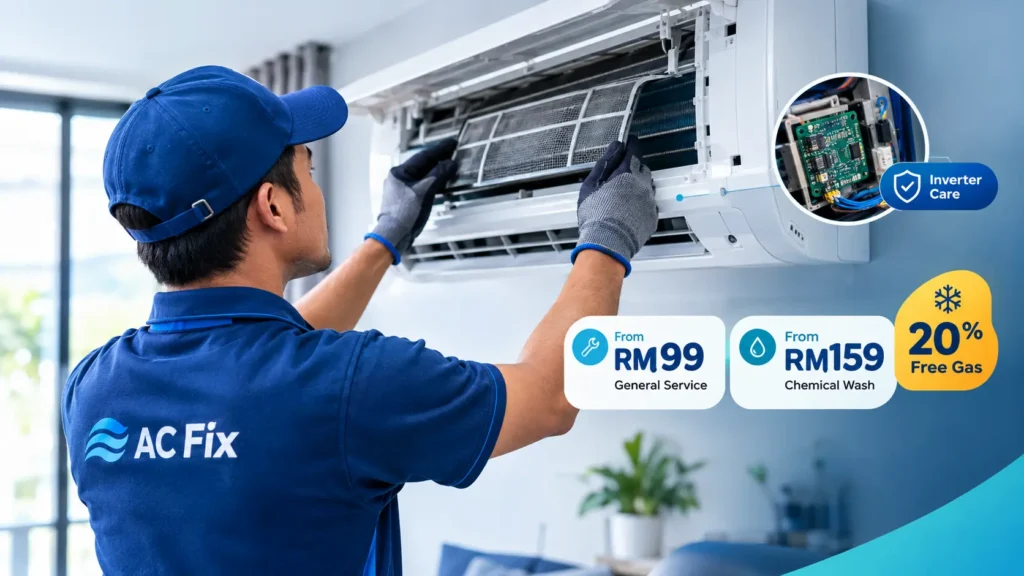
Quick Answer: Inverter aircond servicing in Malaysia starts from RM99 for a general service and RM159 for a chemical wash (1.0–1.5HP wall unit). The price is similar to non-inverter servicing. What changes is the process — technicians need to protect electronic boards from moisture, handle sensors with care, and understand model-specific refrigerant requirements. Routine cleaning is not the same as fault diagnosis, and the two should be quoted separately.
Most homeowners assume inverter units need a “special service” with a special price. They usually don’t. What they need is a technician who knows what to check, what not to touch, and when a routine clean is not enough. If you have ever looked at a chemical wash service and wondered whether it is safe for an inverter board, the answer is yes — with the right precautions.
Need your inverter aircond serviced properly?
JKKP-certified technicians · CSTP-trained for refrigerant handling · Transparent pricing from RM99 · 30-day workmanship warranty
✅ JKKP-Certified · ✅ From RM99 · ✅ 30-Day Warranty
📑 Table of Contents
- Inverter vs Non-Inverter Servicing — What Actually Differs
- Why Inverter Units Need Slightly More Care
- What a Proper Service Should Include
- How Much Does Inverter Servicing Cost in KL & Selangor?
- How Often Should You Service an Inverter Aircond?
- When You Need a Specialist, Not a General Technician
- Mistakes That Cost Inverter Owners Money
- Frequently Asked Questions
Inverter vs Non-Inverter Servicing — What Actually Differs
Both inverter and non-inverter units need regular cleaning. Both have electronic components that must be protected from water and cleaning chemicals. Both need their drains flushed and their cooling performance checked. The honest difference is not in whether care is needed — it is in how much care the electronics can tolerate and how expensive a mistake becomes. You can see this reflected in ACFix’s repair cost guide, where board-level faults on inverter units sit at the higher end of the range.
| Service Point | Non-Inverter (General) | Inverter (General) | Practical Impact |
|---|---|---|---|
| Basic service price (1.0–1.5HP) | From RM99 | From RM99 | Same ACFix rate |
| Chemical wash (1.0–1.5HP) | From RM159 | From RM159 | Same ACFix rate |
| Board protection during wash | Required | Required — higher cost if damaged | Inverter boards typically cost more to replace |
| Sensor handling | Model-dependent | Model-dependent | Not all inverter units have more sensors — check the model |
| Compressor diagnostics | Capacitor & winding test | Board-level diagnostics (if fault suspected) | Different diagnostic skill — not part of routine cleaning |
| Refrigerant type | Model-dependent | Model-dependent | Check the outdoor unit nameplate — never assume |
| Board repair / replacement cost | Varies by model | Typically RM300–RM800+ | Repair and replacement are different jobs — quote separately |
| Compressor replacement cost | RM800–RM2,500 | RM800–RM2,500 | Same ACFix range for both types |
The takeaway is simple: you are not paying more for the cleaning — you are paying for the technician’s ability to avoid creating a repair. A rushed wash on any unit can cause problems. On an inverter unit, those problems tend to cost more to fix — and if the board fails, you are looking at a repair job rather than a cleaning job.
Why Inverter Units Need Slightly More Care
Board Protection Matters on Every Unit — But Inverter Boards Cost More
Both inverter and non-inverter units have electronic control boards. Water and cleaning chemicals should never reach them. What changes on an inverter unit is the cost of getting it wrong. Inverter boards manage variable-speed compressor signals and are typically more expensive to replace than basic control boards on older non-inverter units. A replacement board on a common inverter model can cost several hundred ringgit — the published PCB repair range sits between RM300 and RM800 for most brands — and the diagnostic work to confirm board failure is not free either. That is why a careful technician treats board protection as a basic step on every job, not an optional upsell.
Sensor Count Is Model-Specific, Not Type-Specific
It is tempting to say inverter units have “more sensors” and non-inverter units have “fewer.” That is not reliable. Sensor count and placement depend on the specific model and generation. Some modern non-inverter units have multiple sensors. Some basic inverter units have fewer. What matters is that whichever unit you own, its sensors should be checked and repositioned correctly after cleaning. A loose sensor can cause the unit to cycle on and off or blow warm air — and the fault often looks like something else entirely.
Compressor Diagnostics Are a Separate Job, Not Part of Cleaning
A routine clean does not include a full compressor diagnostic. On a non-inverter unit, a basic compressor check might involve testing the capacitor and winding. On an inverter unit, confirming a compressor fault requires board-level testing — checking whether the board is sending the correct signal, whether the compressor is receiving variable voltage, and whether the inverter module is healthy. That is fault diagnosis, not cleaning. A responsible provider quotes it separately, and only when symptoms or measurements suggest it is needed. If a technician “diagnoses” a compressor problem without tools, they are guessing — and you may end up paying for a repair you did not need.
Refrigerant Type Depends on the Model — Always Check the Nameplate
You cannot tell the refrigerant type from whether a unit is inverter or non-inverter. R32 is used in many current inverter models, but R410A and R22 exist across different generations and model ranges. The only safe way to know is to check the outdoor unit nameplate before any refrigerant work. Using the wrong refrigerant or charging to the wrong pressure can reduce efficiency and stress the compressor. If a technician starts topping up gas without checking the nameplate, stop them. Our gas refill service page explains how proper leak detection and pressure testing should be done before any recharge.
💡 Expert Tip: Before any refrigerant work, ask: “Can you show me the refrigerant type on the outdoor unit nameplate?” If the answer is vague, you are talking to the wrong technician.
What a Proper Service Should Include
Use this as a practical checklist. A routine service should cover the basics below. Fault diagnosis is a separate scope — do not expect it to be bundled into a standard clean. If you want to handle the safe parts yourself, our DIY aircond service guide covers what you can and cannot do without tools.
Routine Service — Core Scope
- Power isolated before any wet work
- Electronic control area covered or protected
- Filters removed, washed, and dried
- Blower wheel cleaned (not just wiped)
- Evaporator coil cleaned — water or chemical depending on condition
- Drain pan and drain pipe flushed
- Outdoor condenser coil checked and cleaned if accessible
- All sensors and connectors repositioned correctly
- Cooling performance tested with a thermometer before leaving
- Written summary of what was done and what was observed
Separately Quoted — Fault Diagnosis
- Refrigerant pressure measurement (a data point, not a final diagnosis on its own)
- Leak detection and repair
- Compressor and board-level diagnostics
- Electrical fault tracing
Do not judge a service by time alone. A small, accessible unit with a light clean can take less time than a heavily soiled unit with difficult access. The better question is: what was checked, and was cooling performance tested before the technician left? If your unit is not cooling properly even after a clean, that is a sign the job was incomplete.
Not sure what your unit actually needs?
Send a photo and your last service date. We will tell you whether a routine clean is enough or whether diagnosis is needed — no upsell.
✅ JKKP-Certified · ✅ CSTP-Trained · ✅ 30-Day Warranty
How Much Does Inverter Servicing Cost in KL & Selangor?
Below are the published ACFix rates for 2026. These are service rates, not fault-diagnosis rates. Repair and replacement costs are quoted separately after diagnosis — you can compare the full breakdown on the ACFix service price page.
| Service Type | 1.0–1.5HP | 2.0–2.5HP | What’s Included |
|---|---|---|---|
| General service | RM99 | RM150 | Filter clean, blower wipe, drain check, performance test |
| Chemical wash | RM159 | RM219 | Deep coil clean, blower clean, drain flush, 20% gas top-up |
| Chemical overhaul | Quoted after inspection | Quoted after inspection | Full dismantle and reassembly — price depends on condition and access |
| PCB / board repair | RM300–RM800 | Quoted after diagnosis | Board-level repair where possible — not always a replacement |
| PCB / board replacement | Quoted after diagnosis | Quoted after diagnosis | New board — price depends on brand and model availability |
| Compressor replacement | RM800–RM2,500 | RM800–RM2,500 | Part, labour, and gas recharge — diagnosis required first |
Source note: Prices reflect ACFix Malaysia’s published rates for 2026 and may change. Actual quotes depend on unit condition, access, and parts availability. Always get a written quote before work starts.
When You Pay More — and When You Shouldn’t
You should expect a higher quote if the unit has not been serviced in over 12 months, if it is a ceiling cassette or floor-standing type, if access needs scaffolding, or if there is heavy mould or grease buildup. You should not pay a blanket “inverter surcharge” on a routine clean. If a company adds 30–50% just because the unit is an inverter, ask for a line-by-line breakdown of what extra work that covers. Installation pricing, for reference, is a separate scope altogether — you can check installation rates here.
How Often Should You Service an Inverter Aircond?
Service intervals are the same for inverter and non-inverter units in Malaysia’s climate. What changes is the cost of neglect — a dirty coil makes an inverter compressor work harder for longer, which is exactly when efficiency drops. The full harga servis aircond rumah guide breaks down the market rates if you want to compare.
Normal Use (6–8 Hours a Day)
- General service: Every 3–4 months
- Chemical wash: Every 12 months
Heavy Use (10+ Hours a Day)
- General service: Every 2–3 months
- Chemical wash: Every 6–9 months
If the unit runs all night in a bedroom and again during the day in a living room, dust and moisture build up faster. A dirty coil makes the compressor work harder to hold temperature, and the electricity cost creeps up quietly before any obvious fault appears. If you are in Kuala Lumpur, the KL service coverage page shows response times by zone.
Signs You Shouldn’t Wait for the Calendar
Book a service or diagnosis if you notice:
- Weak airflow even on high fan speed
- Musty smell when the unit starts
- Water dripping from the indoor unit
- The room takes noticeably longer to cool than last month
- The electricity bill rises without a change in usage
These are early signs of a dirty coil or blocked drain — not necessarily a repair. A routine service usually resolves them before they become expensive. If you are seeing water leaking from the indoor unit, that is usually a blocked drain that a service should have caught. For Selangor homeowners, the Selangor service areas page lists same-day coverage.
When You Need a Specialist, Not a General Technician
Not every technician is trained on inverter diagnostics, and that is fine. General cleaning does not require board-level expertise. But certain problems do. Call a specialist if the unit shows an error code (inverter codes are brand- and board-specific — guessing leads to wrong parts), the compressor will not start (the fault could be the board, the inverter module, or the compressor itself), the unit keeps tripping the MCB, or the board has failed before (the root cause may still be present).
Also consider a specialist if the unit is under warranty. Warranty terms vary by brand — some require servicing by an authorised dealer, others require documented maintenance, and some have no servicing condition at all. Read your manufacturer’s warranty terms before assuming anything. Keep your service receipts and invoices either way, because documentation is the only thing that helps if a claim is questioned later.
For refrigerant handling specifically, the relevant Malaysian credential is the Certified Service Technician Programme (CSTP) issued under the Department of Environment (DOE). Industry associations such as JKKP provide additional trade certification, but CSTP is the credential tied to refrigerant-handling compliance and environmental requirements. ACFix technicians hold JKKP industry certification and are trained under CSTP requirements for refrigerant handling. If a provider claims “government certification” without naming the authority, ask for the exact certificate name.
Mistakes That Cost Inverter Owners Money
⚠️ Avoid These
- Letting any technician wash the indoor unit without covering the electronic control area. Water on a board can cause immediate failure or corrosion that shows up weeks later. Replacement boards are not cheap.
- Topping up gas without finding the leak. Gas does not get “used up.” If it is low, there is a leak. Topping up without repairing the leak means paying again soon — the gas cepat habis guide explains how to trace it properly.
- Assuming refrigerant type from unit type. Check the outdoor unit nameplate. R32, R410A, and R22 exist across different models and generations.
- Treating a pressure reading as a final diagnosis. Pressure is one data point. Charge decisions need more than that.
- Choosing the cheapest quote without asking what is included. Ask whether the drain is flushed, whether cooling performance is tested, and whether the electronic area is protected. A cheap clean that skips these steps is not a bargain — it is a future repair bill.
Frequently Asked Questions
Is inverter aircond servicing more expensive than non-inverter servicing?
At ACFix, general service and chemical wash rates are the same for inverter and non-inverter wall units: from RM99 for general service and RM159 for chemical wash (1.0–1.5HP). The process is what differs, not the published service price. Fault diagnosis and repairs are quoted separately.
How often should I service my inverter aircond in Malaysia?
Every 3–4 months for general service with normal use (6–8 hours a day), and a chemical wash every 12 months. Heavy users (10+ hours daily) should shorten both intervals.
Can a general technician service an inverter aircond?
For routine cleaning — filters, coil, drain, and performance check — a careful general technician can do the job, provided the electronic control area is protected. For error codes, compressor faults, board-level diagnosis, or MCB tripping, you need a technician trained on inverter diagnostics.
What happens if water reaches the control board during a wash?
The board can fail immediately or corrode over time. Symptoms include the unit not turning on, random error codes, or the compressor not starting. Board repair or replacement is a separate cost and should be diagnosed properly rather than guessed.
Does inverter aircond use a specific refrigerant?
Not by default. Refrigerant type depends on the exact model. R32 is common in current models, but R410A and R22 exist across different generations. Always check the outdoor unit nameplate before any refrigerant work.
Will skipping service void my warranty?
It depends on your manufacturer’s terms. Some brands require servicing by an authorised dealer and proof of routine maintenance for compressor claims. Others have different conditions. Check your warranty card or terms, and keep your service receipts regardless.
Book a proper inverter aircond service today
Same-day service across KL & Selangor · JKKP-certified · CSTP-trained for refrigerant handling · From RM99 · 30-day workmanship warranty
✅ JKKP-Certified · ✅ From RM99 · ✅ 30-Day Warranty
Umar Ansari
Lead Technician & Founder — ACFix Malaysia
✅ JKKP-Certified
📅 15+ Years
🇲🇾 KL & Selangor
Umar Ansari is a JKKP-certified technician with 15+ years of hands-on experience across KL and Selangor. ACFix is based in Subang Jaya and has served the region since 2012. acfix.my
JKKP = Malaysian aircond industry association trade certification. CSTP = Department of Environment’s refrigerant-handling certification. ACFix technicians hold JKKP certification and are CSTP-trained for refrigerant handling.