Quick Answer
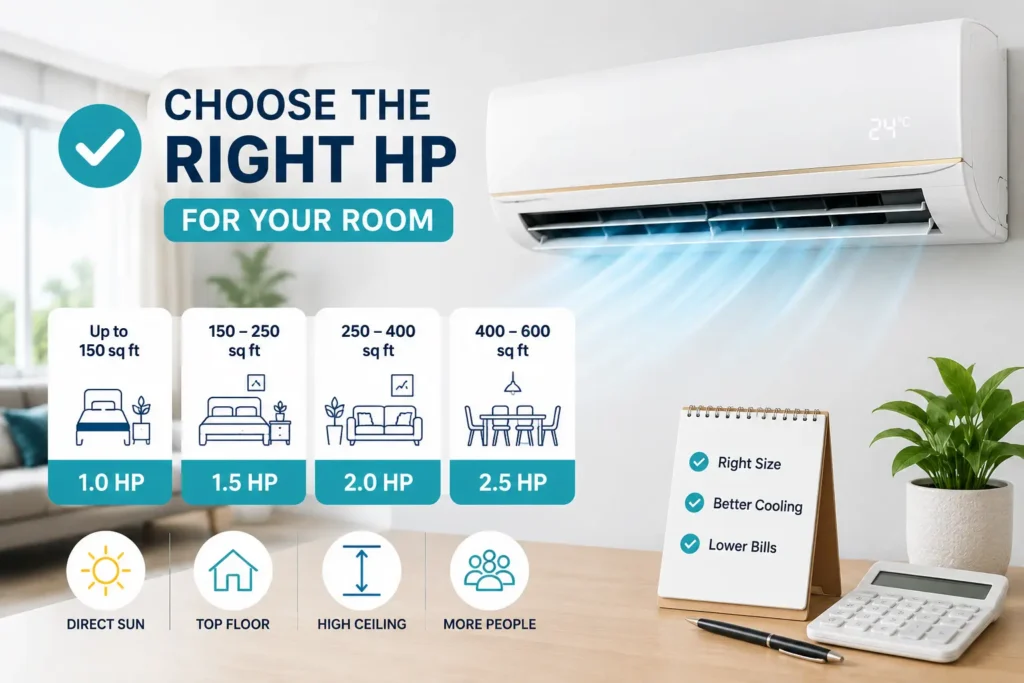
Use this as your starting point: up to 150 sq ft = 1.0 HP, 150–250 sq ft = 1.5 HP, 250–400 sq ft = 2.0 HP, 400–600 sq ft = 2.5 HP. But room size alone is not enough. In Malaysia, the direction your room faces, ceiling height, and whether you are on the top floor can each push your requirement up by 0.5 HP. Keep reading — this guide covers everything.
Walk into any aircond shop in Malaysia and the salesperson asks one question: what size is your room? Then they recommend something and move on. The problem is that the right HP is almost never just about room size. I have been installing and repairing airconds across KL and Selangor since 2012 — and the single most common complaint I hear from new customers is that their unit never feels cold enough. In most cases, somebody sold them the wrong HP.
This guide gives you everything you need to choose correctly. No guesswork. No upselling. Just honest advice from someone who has opened up thousands of units and seen exactly what happens when the size is right — and what happens when it is not.
📖 What This Guide Covers
The Basic HP Size Guide for Malaysia
This table is the industry standard used by most aircond installers across KL and Selangor. It assumes a standard 9 to 10-foot ceiling, a shaded or north or east-facing room, and no unusual heat sources inside the room. If any of those things do not apply to you — keep reading because your number will be higher.
If your room is on the border between two HP sizes — for example, 240 sq ft sitting between 1.5 HP and 2.0 HP — always go up one size. It is always better to have a small amount of extra cooling capacity than not enough. Going up one HP size adds roughly RM200 to RM300 to the unit price. Going undersized costs you years of discomfort and higher electricity bills.
💡 How to Measure Your Room in 60 Seconds
No measuring tape? No problem. Walk the length of your room placing one foot directly in front of the other. The average adult step is about one foot long. Do the same for the width. Multiply both numbers to get your square footage. Example: 12 steps long x 12 steps wide = 144 sq ft — you need 1.5 HP.
Step-by-Step HP Calculation for Malaysian Conditions
This method is more accurate than just looking at room size. It accounts for Malaysia’s specific climate — which is hotter, more humid, and more demanding on aircond units than most countries. Use this when your room has any special conditions like strong sunlight, high ceilings, or many people using it.
Measure your room area in square feet
Length x Width = Square footage. For irregular rooms, break it into smaller rectangles and add them up. Example: a 14ft x 12ft room = 168 sq ft.
Calculate your base BTU requirement
Multiply your room area by 25. This gives your base BTU requirement. Example: 168 sq ft x 25 = 4,200 BTU. This is your starting number — not your final number yet.
Add adjustments for Malaysian conditions
Add 20% if the room faces west or southwest and gets direct afternoon sun. Add 15% if ceiling height is above 10 feet. Add 600 BTU for every person beyond two who regularly uses the room. Add 4,000 BTU if the room is a kitchen or near cooking heat. Add 10% if you are on the top floor of a terrace house or the top three floors of a condo.
Convert BTU to HP
Divide your final BTU number by 9,000. This gives you the HP you need. Round up to the nearest standard size. Example: 5,800 BTU ÷ 9,000 = 0.64 HP — round up to 1.0 HP. 10,200 BTU ÷ 9,000 = 1.13 HP — round up to 1.5 HP.
Worked example — a typical Malaysian master bedroom
Room: 14ft x 12ft = 168 sq ft. Base BTU: 168 x 25 = 4,200. West-facing (+20%): 4,200 + 840 = 5,040. Two occupants (no adjustment needed). Final BTU: 5,040. HP: 5,040 ÷ 9,000 = 0.56 — rounds up to 1.0 HP. But wait — this room faces west. Most installers experienced with Malaysian conditions would recommend 1.5 HP here to ensure comfortable cooling even during peak afternoon heat from 2pm to 6pm.
⚠️ The Formula Is a Guide — Not a Guarantee
BTU calculations give you a good starting point. But an experienced JKKP-certified installer who physically visits your space can account for things the formula cannot — the actual thermal mass of your walls, the quality of your ceiling insulation, whether you have double-glazed windows, and how much time you spend in the room daily. Before buying a high-value unit, a site visit is always worth it.
5 Malaysian Factors That Change Your HP Requirement
These are the factors most people miss when buying an aircond in Malaysia. Each one can push your requirement up by 0.5 HP or more. Ignore them and you will end up with a unit that runs non-stop but never quite gets the room cold enough.
This is the factor most Malaysians never think about — and the one responsible for more “my aircond not cold enough” complaints than any other. A west-facing room gets hammered by direct afternoon sun from around 1pm to 6pm every single day. The walls, ceiling, and floor absorb this heat and radiate it into the room for hours afterwards.
From my experience, a west-facing master bedroom in a standard Malaysian terrace house requires 30 to 40 percent more cooling capacity than an identical north or east-facing room. A room that should be fine with 1.5 HP on the shaded side of the house needs 2.0 HP when it faces west.
Standard Malaysian home ceiling height is 9 to 10 feet. Modern new developments — especially semi-detached houses, bungalows, and premium condominiums — often have ceilings of 11 to 14 feet. A higher ceiling means significantly more air volume that needs to be cooled.
If your ceiling is above 10 feet, add 15 percent to your BTU calculation. A living room with 12-foot ceilings needs noticeably more cooling power than the same square footage with a standard 9-foot ceiling. This is also why older Malaysian homes with low ceilings often feel cooler faster despite having smaller or older units.
If your room is on the top floor of a terrace house or the highest floors of a condominium, the roof absorbs heat all day and radiates it directly into the ceiling of your room throughout the night. This is why top-floor bedrooms feel noticeably hotter than identical rooms on lower floors.
Roof insulation helps but rarely eliminates this entirely in Malaysia. Top floor rooms typically need 10 to 15 percent more cooling capacity. If you have both a top floor room and a west-facing room — the worst possible combination — go up by one full HP size minimum.
People generate heat. Each person in a room adds approximately 600 BTU of heat load. For a standard one or two-person bedroom, this is already factored into the basic calculation. But a bedroom shared by a family with children, or a living room that regularly hosts guests, needs additional cooling capacity.
Three people in a standard master bedroom add 600 BTU to the load — not enough to change the HP on its own, but combined with a west-facing wall or high ceiling, it can push you from 1.5 HP to 2.0 HP.
A room with a large television, desktop computer, gaming setup, or server rack generates significant additional heat that your aircond needs to overcome. A high-end gaming PC alone can generate 500 to 1,000 watts of heat while running. A home office with multiple monitors and a computer is often warmer than a bedroom of the same size with no electronics.
Kitchens are the extreme example. Cooking generates enormous amounts of heat — up to 4,000 BTU from a single gas burner. If you want to cool a kitchen or an open-plan living area that connects to a kitchen, you need to account for cooking heat in your sizing.
Not sure what HP your room actually needs?
Our JKKP-certified technicians assess your room in person before recommending — no guessing, no upselling. Written price before we start. Covering all of KL and Selangor.
Room-by-Room Recommendations for Malaysian Homes
Every room in your house has different conditions. Here is what I typically recommend after 12 years of site assessments across KL and Selangor — not what the brochure says, but what actually works in real Malaysian homes.
Standard master bedrooms in terrace houses are usually 12 x 15 to 14 x 16 feet — around 180 to 224 sq ft. In most cases, 1.5 HP is the right choice. But if your master bedroom faces west, is on the top floor, or has an attached bathroom that adds to the humid air volume — go with 2.0 HP. You will feel the difference every night.
One mistake I see often: people buy 1.5 HP because the room “looks small.” Then they sleep with the temperature set at 18 degrees, the unit running all night, the room still feels warm at 1am, and they blame the brand. The brand is rarely the problem. The HP is.
Living rooms are often the most undersized room in Malaysian homes. A 300 sq ft living room technically needs 2.0 HP on paper — but Malaysian living rooms are almost always connected to a dining area, the kitchen is nearby, people come and go, the main door opens frequently, and large glass sliding doors often face west. Add all of this up and you usually need 2.5 HP for a space that the basic table says needs 2.0 HP.
For open-plan living and dining areas combined — common in modern apartments — the total area can easily be 450 to 600 sq ft. At that size you need 2.5 HP minimum, and in a west-facing unit you should seriously consider 3.0 HP or two separate units.
Standard sized secondary bedrooms in Malaysian terrace and semi-d homes are usually 10 x 12 or 12 x 12 feet — 120 to 144 sq ft. A 1.0 HP unit is the right choice for these dimensions under normal conditions. If the room faces west or is on the top floor, move up to 1.5 HP. There is no point putting a 1.5 HP unit in a 120 sq ft room facing north — it will cool the room in minutes and short cycle for the rest of the night.
A home office with just a laptop is essentially a bedroom — size it the same way. But a proper setup with a desktop computer, multiple monitors, a printer, and a modem generates substantial heat. Add 0.5 HP to whatever the basic room size suggests. A 150 sq ft home office that would normally take 1.0 HP should get 1.5 HP if you have a full desktop setup running for 8 hours a day.
Cooling a kitchen in isolation is rarely practical in Malaysian homes. If your kitchen is enclosed and you want it to stay cool while cooking, you need to add at least 4,000 BTU to account for cooking heat — which pushes even a small kitchen from 1.0 HP to 1.5 HP or 2.0 HP. More commonly, the better solution is an open extractor hood with strong ventilation rather than trying to overcome cooking heat with a larger aircond.
🔧 Buying a new unit? See full installation pricing including all brands and HP sizes.
Condo vs Landed Home — What Changes
The HP sizing advice above applies to standard Malaysian terrace houses and semi-detached homes. Condominiums and apartments have some specific differences worth understanding before you buy.
How condos are different
Condo rooms are generally smaller than landed home rooms of the same price range — developer floor plans maximise unit count, not room size. A “master bedroom” in a KL condo is often 130 to 160 sq ft compared to 180 to 220 sq ft in a terrace house. This usually means 1.0 HP or 1.5 HP is enough for a condo master bedroom where 1.5 HP or 2.0 HP would be needed for the same function in a landed home.
However, condos introduce two factors that offset this: enclosed spaces with less natural ventilation, and upper floor heat load on higher floors. A condo unit on the 20th floor gets more consistent sun exposure on its exterior walls than a ground-floor terrace house. The lack of a yard, trees, or natural shading means condo walls heat up more uniformly throughout the day.
My general rule for KL and Selangor condos: use the standard HP table but add 0.5 HP if you are on the top three floors, and add 0.5 HP if you face west or southwest. These two adjustments together can push a condo bedroom from 1.0 HP to 2.0 HP — which surprises a lot of people but is perfectly correct once you understand why.
Studio apartments and open-plan condos
Studio apartments present a unique challenge because the sleeping, living, and sometimes dining areas are all one open space. The total area is typically 400 to 600 sq ft. A single 2.0 to 2.5 HP unit positioned correctly can cool the entire space. Do not underestimate the positioning — the unit should be installed on the wall opposite the main sleeping area, not directly above the bed where the cold air blows directly onto you while sleeping.
💡 Planning to buy a new unit for a condo?
Before confirming your HP, check with your building management office whether your condo has restrictions on outdoor unit placement or additional electrical load. Some older condominiums have limited electrical capacity per unit that can affect which HP sizes are practical. Our complete aircond buyer’s guide for Malaysia covers this and other pre-purchase checks in detail.
What Actually Happens When You Get the Size Wrong
Most guides tell you to choose the right HP without explaining what goes wrong when you do not. Here is what I actually see when I visit homes with the wrong-sized unit — and what it costs the homeowner over time.
The financial cost of getting it wrong over five years is real. An undersized unit running non-stop can add RM50 to RM80 extra to your TNB bill every month — that is RM3,000 to RM4,800 over five years in wasted electricity, on top of an early compressor replacement that costs RM600 to RM1,200. Getting the HP right at the start saves you more than the unit itself costs.
If your existing aircond runs non-stop without cooling the room properly, read our guide on why your aircond is not cooling and what to check first — it is sometimes a servicing issue rather than a sizing issue, and it is worth ruling that out before buying a new unit.
Common Mistakes Malaysian Homeowners Make When Choosing HP
⚠️ Avoid These 6 HP Sizing Mistakes
✘
✘
✘
✘
✘
✘
The Right Mindset for Choosing HP
Think of your aircond like your car engine. You do not buy a tiny 1.0-litre engine for a large SUV because you want to save on fuel — you end up with a car that struggles, drinks more fuel trying to keep up, and wears out early. The same principle applies to airconds. Match the power to the load, not the other way around.
At the same time, do not buy a 3.0 HP unit for a 150 sq ft room because you want it cold fast. An oversized unit cools quickly, switches off before it can dehumidify, and leaves you in a cold, damp room — which is uncomfortable in a completely different way.
If you have already bought a unit and want to check whether your electricity consumption is reasonable for your HP size, use the free aircond electricity cost calculator for Malaysia — it shows you what your unit should be consuming per month at various usage hours.
✓ Signs You Chose the Right HP
✘ Signs You Got the HP Wrong
Ready to install the right HP aircond for your room?
ACFix Malaysia provides professional installation for all brands across KL and Selangor. We assess your room before recommending. Written price before we start. 30-day workmanship warranty on every installation.
💬 WhatsApp for Free Room Assessment
View Installation Service
Frequently Asked Questions
What HP aircond do I need for my room in Malaysia?
For rooms up to 150 sq ft, use 1.0 HP. For 150 to 250 sq ft, use 1.5 HP. For 250 to 400 sq ft, use 2.0 HP. For 400 to 600 sq ft, use 2.5 HP. But room size is only the starting point. In Malaysia, west-facing rooms, top floor units, high ceilings, and multiple occupants can each increase your requirement by 0.5 HP.
Is 1.5HP enough for a master bedroom in Malaysia?
Yes, for most standard master bedrooms between 150 and 250 sq ft that do not face west and are not on the top floor. If your master bedroom faces west and gets direct afternoon sun, if it is on the top floor, or if the ceiling is higher than 10 feet — go up to 2.0 HP. Running a 1.5 HP unit in a room that needs 2.0 HP means it will run non-stop without ever cooling the room properly, which increases your electricity bill and shortens the compressor lifespan.
What happens if I buy the wrong HP aircond?
Too small: the unit runs non-stop, the room never reaches the set temperature, the compressor wears out early, and your TNB bill is higher than it should be. Too big: the unit cools the room too quickly and short cycles every few minutes, it does not run long enough to remove humidity, and the room feels cold but damp and uncomfortable. Both scenarios lead to higher electricity bills and shorter unit lifespan.
How do I calculate the right HP for my room in Malaysia?
Measure your room length x width in feet. Multiply by 25 to get base BTU. Add 20 percent for west-facing rooms. Add 15 percent for ceilings above 10 feet. Add 10 percent for top-floor rooms. Add 600 BTU for every person beyond two. Divide final BTU by 9,000 to get HP. Round up to the nearest standard HP size.
Should I buy a bigger HP aircond just to be safe?
No. An oversized aircond short cycles — it cools the room so quickly it switches off before it can remove humidity from the air. The room feels cold but damp and clammy. Constant on-off cycling also increases electricity consumption and compressor wear. Choose the right HP for your actual room conditions — not the biggest one available.
Does the direction my room faces affect which HP I need?
Yes, significantly. A west-facing room gets direct afternoon sun from around 1pm to 6pm, adding 30 to 50 percent more heat load. If your room faces west, go up one HP size from the basic guide. North and east-facing rooms are generally cooler and can follow the standard HP table without adjustment.
What HP aircond do I need for my living room in Malaysia?
Most Malaysian living rooms between 250 and 400 sq ft need 2.0 HP. Larger living rooms of 400 to 600 sq ft need 2.5 HP. Open-plan living and dining areas combined can be 500 to 800 sq ft and need 2.5 to 3.0 HP. If the living room has large glass sliding doors facing west or connects to an open kitchen, go up one HP size from whatever the basic calculation says.
Does brand affect how much HP I need?
No. The HP requirement comes from your room — not the brand. A Daikin 1.5 HP and a Midea 1.5 HP have the same cooling capacity. Where brand matters is in how efficiently and reliably they deliver that cooling over years of use. For a guide on which brand performs best in Malaysian conditions, see our complete aircond brand comparison for Malaysia 2026.
Installing a new aircond in KL or Selangor?
ACFix Malaysia covers all areas across KL and Selangor. JKKP-certified technicians. Room assessment included. Written price before we start. 30-day workmanship warranty on every installation. Based in Subang Jaya since 2012.
Umar Ansari is a JKKP-certified aircond technician and the lead installer at ACFix Malaysia with over 12 years of hands-on experience sizing, installing, and servicing aircond units across Kuala Lumpur and Selangor. He has personally assessed and installed units in hundreds of terrace houses, condominiums, semi-detached homes, and commercial premises. All HP sizing advice in this guide is based on real field experience — not manufacturer specifications or theoretical calculations.